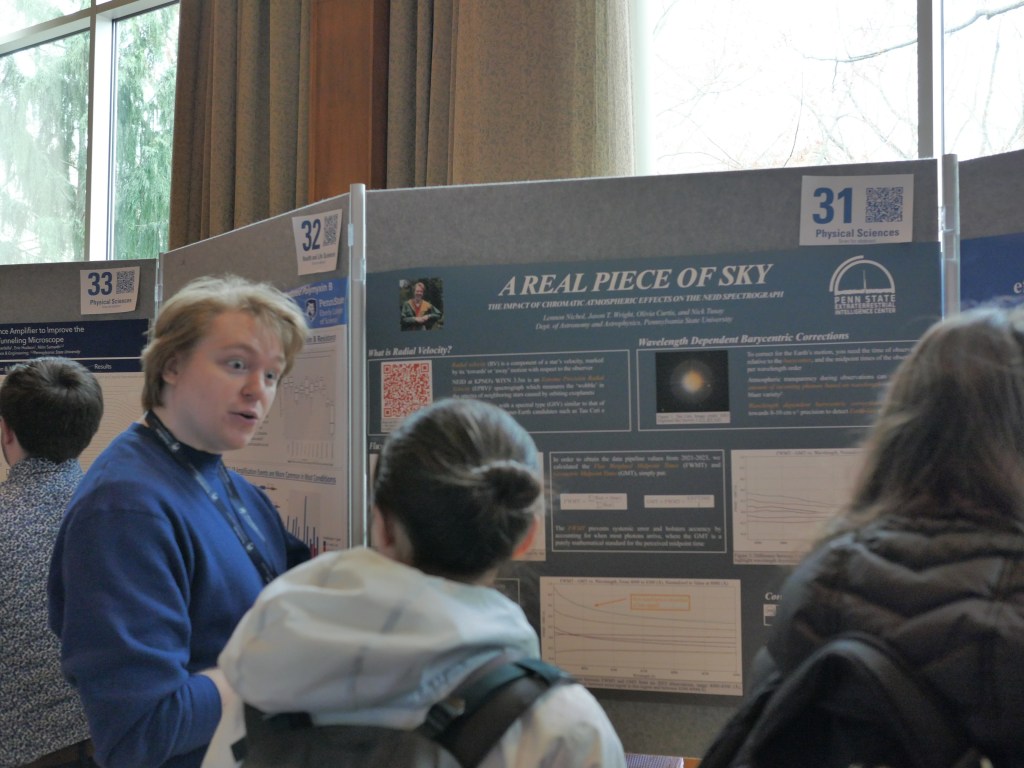
NEID, operating on the WIYN 3.5m telescope at Kitt Peak National Observatory, is a next-generation, high-resolution spectrograph optimized for sub-meter-per-second radial velocity precision, enabling the detection and mass characterization of exoplanets around neighboring stars. We aim to validate that the NEID exposure meter is accurate and functioning as intended via quantifying the uncertainty in the wavelength-dependent barycentric correction, the process of adjusting astronomical observations to account for the motion of the Earth around the barycenter of the solar system. NEID is operating as designed, with its exposure meter and associated data products enabling the extremely precise radial velocity (EPRV) measurements necessary for detecting less massive, terrestrial exoplanet targets. The barycentric corrections derived from the software package barcorrpy provide the timing and velocity precision required to reach ~30 cm/s accuracy. However, a formal verification of these data products—particularly the performance of the exposure meter—has not yet been undertaken. By doing so, we ensure that NEID’s measurements are optimized for precision and that no systematic errors are being introduced in the process and weighting of photon arrival times across the spectral range. This level of precision is crucial to NEID’s primary science goal: achieving 8-10 cm/s radial velocity precision necessary for the detection of Earth-mass exoplanets orbiting Sun-like stars.
We aim to quantify the uncertainty of the barycentric correction applied in NEID observations, with particular emphasis on the time and velocity components: the Barycentric Julian Date in the solar system barycenter frame and the barycentric radial velocity. The times of an observation, from which a corresponding barycentric correction is calculated, are calculated as the flux-weighted midpoint times derived from the flux and time data of NEID’s exposure meter, which accounts for atmospheric transparency and photon arrival rates during an exposure, to the values already calculated by the exposure meter. We will verify that the barycentric corrections computed automatically by the pipeline are correct and robust by examining how often outlier values are recorded and via examining the flux time series by eye. We will also determine the degree to which barycentric corrections vary as a function of wavelength, validating the need for chromatic exposure meters in all EPRV spectrographs. Through a comprehensive evaluation of these components, we seek to quantify the uncertainty associated with the wavelength dependent barycentric correction, ultimately verifying the performance of NEID’s exposure meter and its ability to account for atmospheric conditions.
 Lennon Nichol